

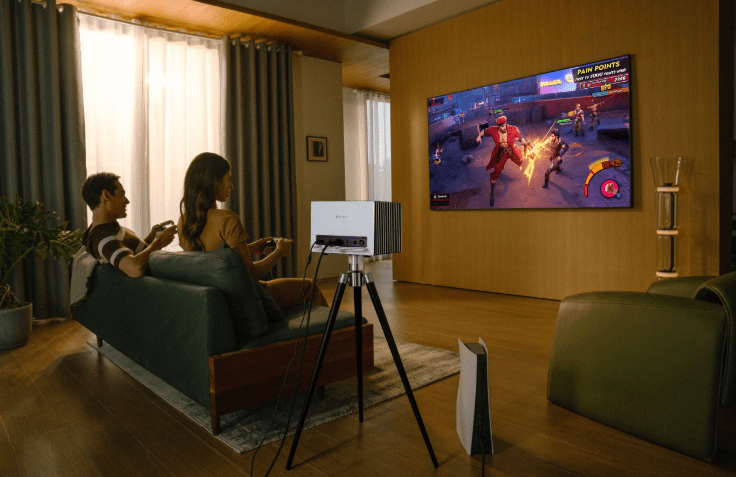
Current-generation gaming consoles are absolute computational powerhouses. For years, the community begged for hardware capable of pushing uncompressed, high-definition graphics at blisteringly fast frame rates. Now that those machines are finally sitting on TV stands in millions of living rooms, a strange and highly common bottleneck has emerged. A massive portion of players take this incredible hardware and plug it directly into standard 27-inch desktop monitors or aging, restrictive televisions.
Doing this is the digital equivalent of buying a high-performance sports car and only driving it through crowded city traffic. The engine under the hood is doing all the heavy lifting, but you are not actually experiencing the full performance. To truly unlock the immersive potential of modern hardware, you have to break away from the physical limitations of traditional glass screens.
Breaking the Glass Ceiling
Desktop monitors are built exclusively for desk-bound productivity and esports efficiency. They force you to sit hunched over a keyboard, staring at a small panel just inches away from your face. Televisions are much better suited for the comfort of a living room, but they hit a hard physical wall. Shipping logistics, manufacturing costs, and plain physics dictate that once a television exceeds 85 inches, the price tag jumps exponentially. You end up with an incredibly heavy, fragile sheet of black glass that completely dominates the room even when turned off.
True immersion relies heavily on manipulating your field of view. When you are navigating a dense, sprawling open-world environment or taking sharp corners in a realistic racing simulator, the digital environment should completely fill your peripheral vision. Dropping a high-quality 4K Projector into your AV setup shatters that 85-inch glass ceiling. It allows you to scale the action up to 100, 120, or even 150 inches without tearing down walls. Enemy characters become life-sized. Tiny user interface text and inventory menus are suddenly readable from the back of the couch. The sheer physical scale of the projection transforms a regular Tuesday night session into an overwhelming, cinematic event.
The Death of the Latency Myth
If you suggest projecting a video game onto a wall to a hardcore player, the immediate pushback is almost always about latency. Ten years ago, this criticism was entirely valid. Older optics processed image data slowly, resulting in a highly noticeable delay between pressing a button on the controller and seeing the character jump on screen. That split-second delay is fatal in competitive multiplayer matches.
However, the technology driving these modern optics has completely evolved. Premium models now utilize bypass modes that shut off the heavy cinematic processing that causes that digital traffic jam. By opening a direct, unfiltered pipeline from the console to the laser light source, input lag drops down to the single digits. You get the massive, wall-filling scale without sacrificing the hair-trigger reaction times required for competitive play.
The Unforgiving Data Pipe: HDMI 2.1
You cannot talk about next-gen capabilities without talking about the physical cables carrying the data. Pushing millions of pixels at 120 frames per second requires an astronomical amount of bandwidth. If the display hardware does not have the right ports, the console will automatically throttle the graphics down to a lower, slower tier to prevent the system from crashing.
This is exactly why selecting a dedicated Gaming Projector requires checking the back panel. It must feature certified HDMI 2.1 inputs. Without this specific port, you are actively choking the console’s output.
| Display Connection Standard | Maximum Bandwidth | 4K Frame Rate Limit | Variable Refresh Rate (VRR) |
| HDMI 1.4 | 10.2 Gbps | 30 Hz | Not Supported |
| HDMI 2.0 | 18.0 Gbps | 60 Hz | Rarely Supported |
| HDMI 2.1 | 48.0 Gbps | 120 Hz | Fully Supported (Native) |
The jump to HDMI 2.1 provides the massive 48 Gbps data pipe needed for uncompressed, high-speed graphics. It also unlocks Variable Refresh Rate (VRR). In graphically intense moments—like massive on-screen explosions—console frame rates can briefly dip. VRR forces the display to synchronize its refresh rate perfectly with the console in real-time, preventing the ugly, horizontal “screen tearing” that ruins the visual experience.
Building the Optimal Play Space
Scaling up your display size means you need to rethink the physical layout of your room. Pushing a giant image requires a bit of environmental control to ensure the high-definition graphics remain razor-sharp and vibrant. Before you boot up your console, make sure you have addressed these core physical requirements:
- Manage Your Ambient Light: Modern laser optics are incredibly bright, but throwing a picture onto a basic white wall in a sunlit room will inevitably destroy your contrast. Pair the hardware with an Ambient Light Rejecting (ALR) screen. These specialized surfaces bounce the projected light directly back to the sofa while absorbing stray light from windows and ceiling lamps.
- Fix the Audio Routing: Consoles handle visual and audio data differently. If you are routing your game audio through a standard Bluetooth connection to a soundbar, you will likely experience a severe audio delay. Always hardwire your headset directly into your controller or rely on a dedicated 2.4GHz wireless dongle for synced sound.
- Secure the Network: If you are playing competitive shooters on a 120-inch screen, network lag is jarring. Do not rely on a weak Wi-Fi signal for this kind of setup. Run a dedicated Ethernet cable directly from your router to the back of the console to ensure a completely stable connection.
- Check the HDMI Run: If your console sits far away from the lens, standard copper HDMI cables will fail. A 20-foot copper cable simply cannot carry 48 Gbps of data without flickering or dropping out entirely. You must use an Active Optical Cable (AOC) to transport the signal over long distances cleanly.
The hardware sitting under your television was built to push the boundaries of digital entertainment. Plugging it into a tiny desktop monitor or a restrictive glass television means you are only experiencing half of what the developers actually intended. Upgrading your visual real estate matches the immense processing power of the console with a physical scale that does the graphics justice. Once you experience your favorite titles on a massive, fast, zero-latency canvas, playing on a normal screen will forever feel like looking at the game through a tiny window.