

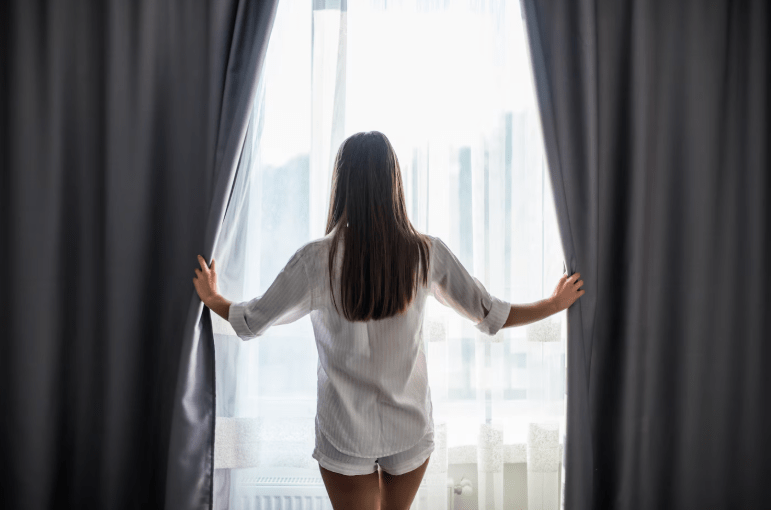
Most homeowners are unaware that light and noise tend to interfere with sleep. Blackout curtains enhance the comfort and privacy of homes by filtering external light, noise, and assisting in more quality of sleep. This guide reveals the most significant advantages and what should be addressed prior to deciding on a blackout style.
Explaining how blackout curtains enhance home comfort and privacy
How blackout curtains block unwanted light
The blackout curtains are made by tightly knitting or layering fabric in order to block the light in a room. This construction is unlike typical curtains that are used to permit different degrees of light. The outcome favors darker rooms either in the daytime or the night. Reasons why blackout fabric is different include:
- Dense fabric weave: This is a tightly built material that minimizes light penetration much more than the normal curtain fabric.
- Multiple fabric layers: Extra support layers to support light blocking capabilities within bedrooms and living rooms.
- Edge coverage design: Larger panels minimizing the light gaps on the sides and top of a window frame.
- Colour and lining effect: Darker linings even minimize the brightness compared to light and uncovered fabric variants.
Supporting better sleep through darker rooms
The quality of sleep is usually greatly based on the darkness of a bedroom during the night period. Natural sleep patterns can be disrupted by streetlights, early sunrise and passing headlights. Black out curtains minimize such distractions. Sleep-related benefits normally consist of:
- Reduced light disruption: On early mornings, blocking outside sources of light which interfere with natural sleep patterns.
- Consistent darkness: Having a dark environment that can accommodate shift workers or other sleeping patterns.
- Improved nap conditions: Supporting daytime naps among young children or alternating household activities.
- Better wake consistency: The lessening of early exposure to light that may cause natural wake periods to occur sooner than desired.
Enhancing privacy throughout the home
Privacy is also one of the most common issues among houses that are exposed to busy streets, or close neighbors. The blackout curtains give a some sort of visual effect that is not always capable of being matched by normal curtains. This privacy enhancement promotes comfort during the daytime and nighttime. Some privacy advantages that can be considered are:
- Reduced visibility from outside: Thicker fabric that does not allow outside visibility even when the inside lights are turned on.
- Evening privacy-support: Blocking silhouettes usually visible when the lights are on using the regular curtains.
- Street-facing room comfort: Added coverage based on either bedrooms or living rooms that are located close to the footpaths or roads.
Additional comfort benefits beyond light control
Blackout curtains have advantages other than being light blocking. The comfort of a home is aided by both the thermal and noise insulation. These are the extra advantages that will result in blackout curtains being a viable option in various rooms. Other comfort benefits typically involve:
- Thermal insulation support: The reduction of heat loss in winter, the increase in heat gain in summer.
- Reduction of noise: Dampening outside noise, favoring less noisy bedroom and home office environments.
- UV protection: Minimizing the sun exposure which may cause fading of furniture, flooring and soft furnishings around.
- Energy efficiency support: The limitation of using heating and cooling systems by means of better insulation.
A look at the frequently asked questions
Can blackout curtains be used in living rooms?
Yes, they perform more than well in any room that would require more control of the lights or privacy.
Do blackout curtains lessen noise?
Yes, heavier fabric helps to dampen external sound to some extent.
Are blackout curtains energy saving?
Yes, insulation can be added that can lessen heating and cooling.
Are blackout curtains to be combined with sheer curtains?
The possibility to pair them provides an opportunity of flexibility in privacy and control over light during the day.