

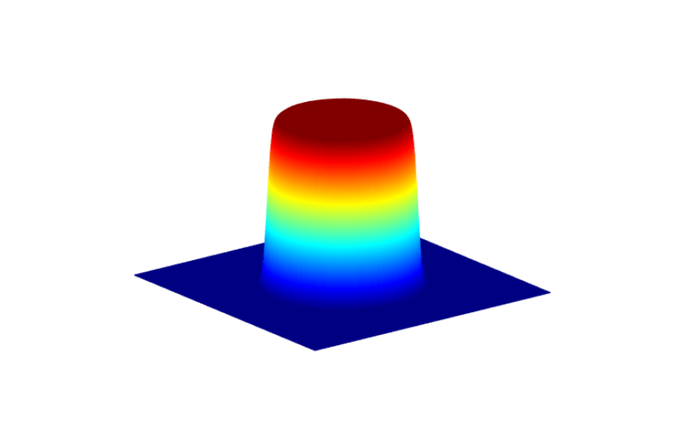
The output light beams from most laser systems follow a Gaussian distribution pattern. The Gaussian irradiance profile depicts a specific pattern where the irradiance reaches its highest value at the center and the value gradually decreases towards the edges, but never reaches zero value. Due to this phenomenon, the Gaussian profile shows an indefinite expansion, resulting in a significant loss of light energy. However, when it comes to utilizing a laser beam system in practical applications, this energy creates a broad edge to the processed area and a wide heat affected zone (HAZ).
A laser beam shaper can solve this issue by shaping the input beam so that a new distribution pattern with uniform irradiance and sharp edges can be attained. Therefore, a laser beam shaper helps lessen the loss of energy and eliminate the input beam’s irregularities.
Types of Laser Beam Shapers
Depending on the properties and the operating principles, there are different types of laser beam shapers. For instance, some laser beam shapers employ the refractive principles while others operate utilizing the principle of diffraction. Whereas a diffuser laser beam shaper shapes the input light beam by shuffling the phase and overlapping the beam, an analytical laser beam shaper work on a predetermined single mode beam with a known diameter and shapes it while maintaining a smooth phase. The four main types of laser beam shapers are Diffractive Diffusers, Top Hat Beam Shapers, Broadband Diffusers, and Micro-lens Arrays.
Beam Shapers that Follow the Diffractive Principle
The Top Hat Beam Shapers and Diffractive Diffusers operate on the diffractive principle to create a specific beam profile with consistent irradiance and sharp edges. Diffractive diffusers shape the beam by overlapping it on itself multiple times, resulting in a uniform intensity envelope with sharp edges, but internal uniformity is coherence dependent and may have speckles – the less coherent the laser, the better . Beam shapers, on the other hand, re distribute the laser power from the gaussian center to the edges smoothly, resulting in a flat intensity profile with no speckles and a smooth phase.
Beam Shapers that Follow the Refractive Principle
Broadband Diffusers and Micro-Lens Arrays (MLAs) follow the principle of refraction to modify the input light beams. MLAs act on incoherent input beams to obtain uniformity in irradiance level but often with order artifacts. Conversely, Broadband Diffusers help to bring better uniformity in irradiance level and fewer order artifacts by utilizing randomized lenslet profiles.
Beam Shaping Solutions
There are three main types of beam shaping solutions, such as a) single-mode laser solutions, b) multi-mode laser solutions, and c) refractive beam shaping. For single-mode laser beams, two common methods of beam shaping are angular beam shaping and focal beam shaping.
Laser beam shapers that are used for multi-mode laser solutions are diffractive diffusers, Broadband Diffusers and Micro-Lens Arrays.